

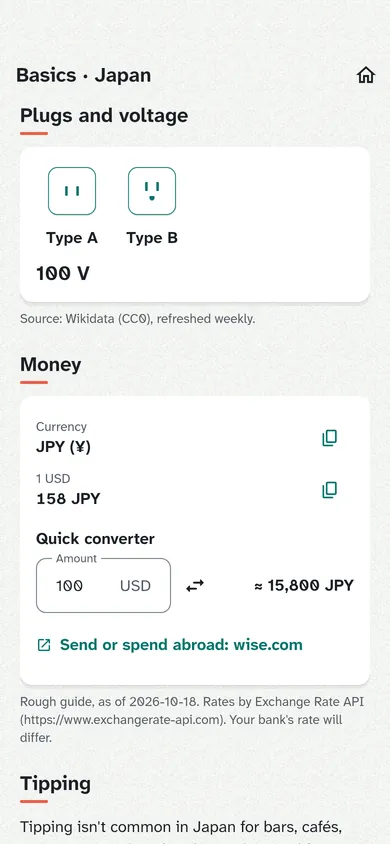
Type A
Two flat parallel pins.
Common in: United States, Canada, Mexico, Japan.
Travel basics
Before you pack the charger, see what the socket looks like where you are going. TripEase shows the plug types and voltage for each destination, and works offline.
Two flat parallel pins.
Common in: United States, Canada, Mexico, Japan.

Two flat pins plus a round earth pin.
Common in: United States, Canada, Mexico.

Two round pins (the Europlug).
Common in: Most of Europe, and much of Asia, Africa and South America.

Three large round pins in a triangle.
Common in: India, Nepal, Sri Lanka, Namibia.

Two round pins with a hole for the socket's earth pin.
Common in: France, Belgium, Poland, Czechia, Slovakia.

Two round pins with earth clips on the sides (Schuko).
Common in: Germany, Spain, the Netherlands, Austria, Sweden.

Three rectangular pins in a triangle.
Common in: United Kingdom, Ireland, Malta, Cyprus, Singapore, Malaysia, Hong Kong.

Three pins in a Y shape.
Common in: Israel.

Two angled flat pins in a V, often with an earth pin.
Common in: Australia, New Zealand, Argentina, mainland China.

Three round pins in a triangle, in a hexagonal-shaped socket.
Common in: Switzerland, Liechtenstein.

Two round pins plus an earth pin, in a round socket.
Common in: Denmark, Greenland.
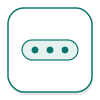
Three round pins in a row.
Common in: Italy, Chile.

Three round pins, larger than Type D.
Common in: South Africa, Lesotho, Eswatini.

Three round pins, in a hexagonal-shaped socket.
Common in: Brazil, South Africa.
Voltage differs by country: roughly 100 to 127 V in the Americas and Japan, and 220 to 240 V in most of the rest of the world. Where each type is used comes from the IEC World Plugs guide; TripEase's per-country plug and voltage data comes from Wikidata (CC0) and is checked against IEC World Plugs for some countries. Sockets can differ from the national standard, so check before you travel. Pictures are TripEase's own drawings.
In the app
Each country's Basics screen shows the plug types used there and the voltage, with the source noted. It works offline.
Questions
An adapter changes the shape of the plug so it fits the socket. It does not change the voltage. A converter or transformer changes the voltage. Many phone and laptop chargers accept 100 to 240 V and need only an adapter.
Read the label on the charger or device. If it says "Input: 100-240V" it handles both main voltage ranges. If it shows one number, such as 120 V, check that it matches your destination before you plug in.
Yes. Many countries have sockets that take several types, and older buildings can differ. A universal adapter covers most cases. Treat the lists on this page as a guide and check before you go.